Best Social Media Marketing Tools For E-commerce Companies
September 21, 2021
Divya Dhawan
E-commerce is a booming industry. With more and more people choosing to purchase products and services online, the market for an ecommerce business is massive and can be highly profitable if approached in the right way.
Whether you're operating a small or large ecommerce business, social media must be one of your campaign channels. Every company should utilize social media networks to increase brand recognition and sales by attracting more consumers and increasing brand exposure.
We know that the way we work is almost completely different from what it used to be. This has facilitated ecommerce brands to showcase their products and services online now instead of retail stores.
Online businesses have increased the importance of social media for social selling more than ever. That's why social media strategies help e-commerce businesses to market their products and increase brand awareness.
According to Hootsuite's research, 81% of consumers use Instagram to learn about goods and services. Therefore, it is reasonable to assume that social media accounts are becoming the brand's primary source of information.
As a result, you should speed up your marketing campaigns by the following flow. It would be ideal to use e-commerce and social media as marketing tools to develop your brand positioning on social media.
How to Use Social Media for e-commerce
There are numerous methods to employ social media marketing for e-commerce. Here are some pointers for using social media to promote your products and increase sales in your e-commerce business.
Increase brand awareness
Digital advertising on social media
Market products through social media
Brand reputation management
Interact with customers through social media
Using social media as a preview for your online store can help to raise brand awareness. As you know, establishing a community for your business is difficult for new organizations. It will be simpler for you to be inspired by your competition at this point. It's also fascinating to learn about what they're doing on social media in greater detail. This will aid you in being more distinctive on social media. You'll also learn how to distinguish your company from others.
Paid advertising is an essential component of any successful social media marketing campaign. Advertising on social networks allows you to reach a much larger audience or a more targeted demographic through Facebook, Instagram, and other platforms. To entice more people to your online store, utilize Facebook & Instagram tools to target your desired demographic.
After following the suggestions for enhancing your Facebook eCommerce campaign, you'll be able to easily reach your target demographic and sell your products.
You'll also have more of a chance to interact with your prospects and existing customers via social media. Using your social media platform as customer service will help you develop a strong bond with your audience.
Engaging with the audience on comments demonstrates that you value their thoughts about your products and services. That's why these social media platforms will help protect your brand's reputation.
What is Social Media e-commerce Marketing?
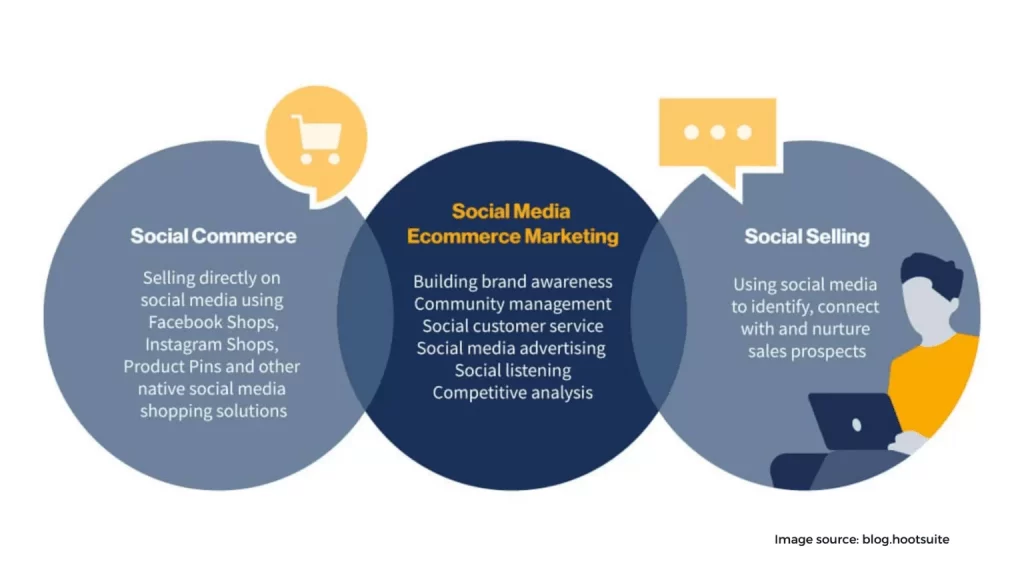
E-commerce marketing on social media is a collection of methods for promoting your products and services through social media. It also covers the product's brand awareness stage, social media advertising, product promotion, and many other topics.
When it comes to how social media techniques for e-commerce businesses may be implemented, SaaS solutions are on hand. We've put up a list of the top five social media management tools for e-commerce, as well as their essential features.
Iconosquare is a social media e-commerce marketing software that you should try out if you want to increase your e-commerce business. Companies must develop more interaction, internet presence, and user-generated content for successful social media marketing. In addition, perhaps the most effective approach to increase interaction is influencer marketing.
You're able to use the program to make a list of all your social media followers, which you can then check for updates. This feature allows you to create more engaging postings by allowing you on-the-fly marketing strategies for your e-commerce firms. For example, after you've published social media advertising for your post, you may assess the campaign's success in one area.
This is an easy-to-use tool for interacting with your audience in real-time, allowing you to boost interaction and followers.
Iconosquare comes with several other useful features, including monitoring capabilities. You can compare and analyze your rivals in real-time, essential for improving your e-commerce store. Finally, it reduces your time on social media and helps you develop new strategies for your social network accounts.
Agorapulse
Agorapulse is a social media marketing software that has the functionality of posting, tracking, and reporting. It keeps track of which content performs best on your social media platforms and reports the results. It's comparable to the organic reach, sponsored reach, total reach, clicks, and active users for your content.
As a comprehensive social media e-commerce marketing solution, it allows you to moderate Facebook and Instagram comments, monitor major developments in your social media feeds, and interact immediately with your followers. After completing this analysis, you should establish an Instagram e-commerce plan for your company. Another great feature is Agorapulse includes a monitoring option for comments, allowing you to respond to the UGC promptly and interact in real-time.
Its mobile app version is a one-of-a-kind solution for the e-commerce sector's social media marketing tools. You may keep an eye on your social media from any location. It's possible to monitor paid reach on Agorapulse, which is one of the features of social e-commerce. The key to generating many leads is to develop unique strategies for using paid social media and utilizing these advertisements.
HubSpot Marketing Hub
HubSpot Marketing Hub is an all-in-one marketing platform that lets you manage your social media presence. It includes a full inbound marketing strategy for growing your e-commerce business, including a CRM, marketing, and sales hub.
The functionality is similar to what you've seen in the previous ones, such as creating articles, interacting with your followers, and gaining useful information through reports. You may also access a paying customer's journey through social media by clicking on a social post.
If you want to take advantage of all of HubSpot's features, they will immediately improve your revenues via integrated marketing communication. However, if you want to use the social media feature for your e-commerce marketing, it is far more expensive than other social media channels.
The biggest benefit of the HubSpot Marketing Hub is that it allows you to keep track of a customer's entire journey, which is especially useful for e-commerce companies.
Hootsuite
Hootsuite is another excellent social media management tool for your e-commerce company. It has all the functions you'll need, including creating social media posts on a timetable, engaging with the audience, and measuring performance. These capabilities allow you to set up a social media strategy for your e-commerce firm from one spot by allowing you to save time.
It's a simple ecommerce platform, so you may use it to control your advertisements using various tools. In addition, you'll be able to sell your goods on social media with social e-commerce.
E-commerce companies may use native advertising on Facebook and Instagram. These tactics will assist you in increasing your sales. Hootsuite also enables you to gather, evaluate, and develop new marketing campaigns for your organization.
Hootsuite also includes enhanced tools for managing your advertisements, which is known as "Hootsuite Ads." With this tool, you may rapidly generate and launch campaigns. This is one of the most important and distinctive elements that any e-commerce business should have for growth.
SproutSocial
Sprout Social is a social media marketing tool for e-commerce that you may use to grow your online business on social media. It also covers engagement modules, publishing and scheduling, social media analytics, and social listening.
Unlike the other tools we've looked at, they include social commerce features particularly geared toward e-commerce companies. In addition, they provide a wide range of innovative solutions for integrating social media and e-commerce.
With various functions like social commerce, they focus on increasing your social ROI. For example, you can link your Facebook or Shopify account with social media sites using this module.
These platforms can also aid you in developing a digital marketing strategy to enhance the success of your e-commerce store.
Sprout Social has several integrations with CRM solutions, as well. So you may follow the customer journeys of your social media followers and convert them into customers.
Final Takeaway
All people are well aware of the impact of social media marketing on e-commerce growth in recent years. However, we've discovered that establishing an online shop isn't simple enough without tools and connections with this research.
It is self-evident that social media significantly influences brand recognition and product sales. Therefore, the following are the steps you should take: establish an online presence on social media, develop a deeper knowledge of your rivals, engage with your followers, interact frequently, nurture them with tailored communications, be attentive to their needs, and post-user-generated content, and many more.
To succeed on social media for your e-commerce business, you must focus on social commerce metrics and discover the ideal e-commerce social media tools.
Determine your needs and then, take a look at the tools' capabilities and pick the one that's appropriate for your e-commerce business.
Loved What You Read? Stay Inspired!
Don’t miss out on exclusive insights, tips, and updates. Sign up now and be the first to explore fresh ideas!
Cold-calling volume is declining in effectiveness, wasting time and budget. The A.C.E.S.™ method replaces heavy dialing with five personalized, well-timed touches and a short silent window to boost recall and replies. Teams achieve equal or better meetings with fewer calls and higher efficiency.
What happens when sales reps get instant feedback instead of silence? Salesforce Arcade shows that making effort visible can boost daily dials by 25%—without new incentives, pressure, or burnout. Sometimes performance doesn’t need a new target, just a better experience.
Most sales emails stall because trust shows up too late. The Social-Proof Sandwich fixes that by placing testimonials right where decisions happen—mid-email—boosting replies and demos with smarter timing, not more words.
In modern B2B sales, interest peaks briefly and fades quickly. Teams that respond within minutes often shape the conversation, set expectations, and move opportunities forward. Clear response ownership, thoughtful use of automation, and timely human follow-up turn speed into a durable advantage.
Cold emails often fail not because the message is weak, but because it arrives before familiarity exists. By engaging thoughtfully with profiles and posts before sending an email, sales professionals can create warmer conversations, faster replies, and more natural first interactions.