logo-Amplispot
Review Generation, Done Right

Turn Front-Desk Staff Into a Review-Generation Channel

Ask most multi-location operators how their front-desk team drives reviews and you will hear one of two answers. Either the team hands customers a tablet before they leave, or they do not do anything at all. As of 2026, the first approach is a Google policy violation that is getting profiles flagged and review histories wiped overnight. The second approach leaves the single most effective review-generation channel in any customer-facing business sitting completely unused. The answer that actually works sits between those two, and it is less complicated than most groups think once the right system is behind it.
the ask, sent the compliant way
0

Extra website visits generated per additional review

0

Will leave a review for a business if they are asked

0

Review-response rate that marks the revenue threshold

0

More revenue earned by businesses that clear that threshold

Key Takeaways

The Short Version

70 to 80% of customers will leave a review when asked at the right moment, while almost none do so unprompted, which makes the ask itself the most important variable in any review generation strategy.
Google's 2026 policy update explicitly banned tablets at the front desk, on-premises review kiosks, staff review quotas and asking customers to leave reviews before they walk out the door, with active enforcement already removing reviews and flagging profiles.
The compliant path, which is asking customers after they leave on their own devices, is also the higher-converting path because it removes the social pressure that suppresses honest feedback when a customer is still face to face with staff.
Front-desk staff are uniquely positioned to identify the right moment and the right customer for a review ask, but only if they have been given a frictionless, personalised way to make that ask without it feeling like a script.
Centralised review management platforms give multi-location groups the infrastructure to make this work consistently across every outlet, rather than leaving it to individual initiative that produces wildly uneven results.
The Compliance Problem

First, the Approach That Is Getting Brands Into Trouble

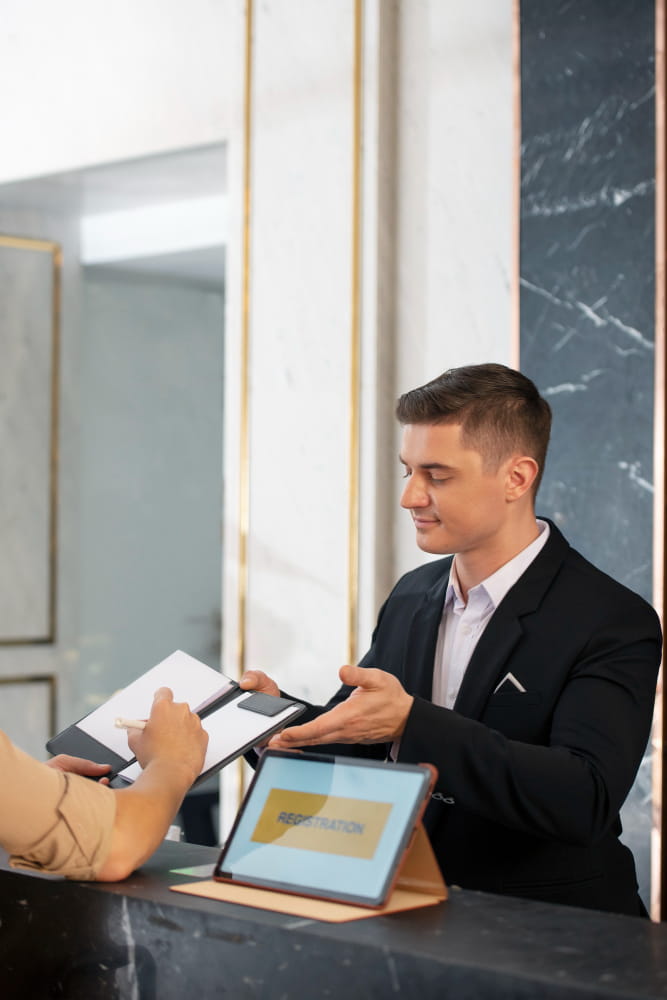
The tablet at the front desk seemed like a genius idea when it became popular, and for a few years it worked well enough that it spread across healthcare, fitness, automotive, hospitality and retail as standard practice. You complete the service, the receptionist slides a tablet across the counter and the customer taps out a review before they leave. Fast, easy, high volume.
Google's 2026 review policy update formally banned it. The updated policy states that merchants should not require or pressure users to leave ratings while on the premises, and shared-device reviews, multiple reviews from one device or IP address, trigger Google's spam detection filters regardless of how they were collected. A 12-location operator had three of their best-reviewed locations disappear from Google Maps overnight because of exactly this setup, with every review tied to the kiosk removed and the profiles flagged. Beyond kiosks, the 2026 update also banned staff review quotas and leaderboards, asking customers to mention specific staff members by name, offering discounts or loyalty points in exchange for a review and review gating, which is the practice of pre-screening customers by sentiment before deciding who gets a review request link.

Google's AI-driven enforcement is actively removing non-compliant reviews and repeated violations can lead to profile restrictions or suspension, which for a multi-location group means the review infrastructure that took years to build can disappear from multiple outlets simultaneously. The good news is that the compliant approach is not harder. It is actually more effective.
The Better Moment to Ask

Why Does the Post-Visit Ask Convert Better Anyway?

Think about what happens when a customer is still standing at a front desk and a staff member asks them to leave a review. They are face to face with the person who served them, they may not be fully sure how they feel about the experience yet, and they are in a social situation where saying no feels awkward and leaving anything less than five stars feels even more so. The result is reviews that skew artificially positive, which Google increasingly detects as a manipulation pattern, and a review content quality that is thin because the customer wrote something quickly to end an uncomfortable moment rather than reflecting genuinely on their experience.

A review request that reaches the customer after they have left, on their own device, when the experience has settled and they are comfortable, produces a different quality of response and a much more defensible review profile. 71% of people will leave a review for a business if they are asked, and one of the best moments to ask is immediately after a successful service experience, when satisfaction is high and the experience is fresh, but the customer is on their own phone and their own time rather than standing at your counter under social pressure.

The front-desk staff's role in this model is not to collect the review. It is to identify the right moment, make a warm human connection and trigger the follow-up that does the actual asking through a channel the customer controls.
customer standing at front-desk
Three Things Most Groups Are Missing

What Front-Desk Staff Actually Need to Make This Work

Here is where most multi-location groups get this wrong. They tell staff to ask customers for reviews, without giving them anything concrete to do with that instruction, and the result is some staff who ask occasionally and awkwardly, some who never ask at all and zero consistency across locations. Turning the front desk into a genuine review-generation channel requires three things that most groups have not put in place.
The First Thing
A Personalised Link, Shared in Seconds
Not a generic link to the brand's Google Business Profile that a manager found six months ago, but an individual link assigned to each team member that routes to the right location's review page and can be sent instantly via WhatsApp, SMS or email at the moment the customer interaction ends well. Amplispot's Review Management platform generates these individual shareable links for each staff member across every location in the network, so the ask takes three seconds and the customer receives a direct path to the review page on their own device, in their own time, without any on-premises pressure.
The Second Thing
A Clear Signal for When to Ask
Staff should not be asking every customer, because asking someone who expressed a complaint during their visit or who left visibly frustrated will produce a negative review rather than generating a positive one. The skill the front desk needs is reading the exit: a customer who says thank you warmly, comments positively on the service or returns a genuine smile is the right person to ask. That judgment call is easy for any experienced front-desk person to make, but it needs to be named and trained rather than assumed.
The Third Thing
Visibility Into Whether It's Working
Each additional Google review generates an average of 80 additional website visits, 63 direction requests and 16 phone calls, which means review generation is directly tied to new customer acquisition at every location, and that connection needs to be visible to the team generating those reviews. Amplispot's rating milestone campaigns show each location exactly how many positive reviews it needs to reach the next competitive rating threshold, with individual staff link tracking giving managers a clear view of which team members are contributing to review volume and which are not yet using the channel at all.
Scaling the Habit

Why Consistency Across Locations Is the Actual Challenge

A single-location business can solve this problem through culture and individual effort. A network of 20 or 50 locations cannot, because the variation between a front-desk team that has internalised the review ask as a natural part of every checkout interaction and one that never thinks about it at all is the difference between 40 reviews in a month and three. That variation, compounding across every outlet in the portfolio, is what produces the uneven rating spreads that make a multi-location brand look inconsistent in local search and less credible to customers comparing two nearby outlets.

Businesses that respond to at least 25% of their online reviews earn approximately 35% more revenue than those that do not, which means the full loop matters: generating the reviews through front-desk asks, and then closing that loop with governed responses that reach every reviewer with brand-consistent voice and timing. Amplispot's platform connects both sides of this, with AI-drafted responses routed through an approval workflow enforcing response SLAs so that the reviews a well-trained front-desk team generates are answered with the same consistency that those reviews were earned, rather than disappearing into an inbox that nobody monitors across every outlet in the network.

The presence management infrastructure that sits alongside the review layer ensures that the local search profiles customers land on when a front-desk ask converts to an actual review are accurate, complete and configured to capture the local search visibility that a growing review profile earns. There is no point building review velocity at the front desk if the Google Business Profile the customer arrives at is incomplete or carrying listing errors that suppress the ranking benefit those reviews should be generating.
FAQ

Frequently Asked Questions

Can front-desk staff verbally mention reviews to customers before they leave?
A warm, unpressured mention is different from a formal ask that puts a customer on the spot while they are still on your premises. The key distinction in Google's 2026 update is pressure and shared-device collection: a staff member genuinely saying "if you enjoyed your visit today, a Google review would mean a lot to us" as a customer is leaving is not the same as handing them a tablet. The follow-up request should still go to the customer's own device after they leave, because that is where the review will come from without triggering spam detection.
What is the right timing for the follow-up review request after a visit?
Immediately after a successful interaction produces the highest conversion rates, which in practice means a WhatsApp or SMS within the same hour the customer leaves rather than a bulk email sent the following morning. The experience is freshest and the satisfaction is highest in the first few hours after a positive visit, and a request that arrives while the customer still remembers the specific thing that made the experience good produces a more detailed and useful review than one that arrives two days later.
How should multi-location groups handle staff who are reluctant to ask for reviews?
The most common reason staff do not ask is that they do not have a frictionless way to do so and they are worried the ask will feel awkward. Giving each team member a personalised shareable link they can send from their own phone in three taps removes the friction entirely, and training that frames the ask as sharing a resource rather than making a request shifts the tone from uncomfortable to natural. Visibility into which staff members are generating review volume also gives managers a coaching conversation to have rather than a behaviour they can only observe indirectly.
What happens to a multi-location group's review profile if the 2026 policy violations go uncorrected?
Google's AI-driven enforcement is actively removing reviews collected through banned methods, and repeated or ongoing violations can lead to profile restrictions or suspension across the affected locations. For a multi-location group running shared-device kiosks across 20 outlets, the risk is not one profile being flagged but an enforcement event that affects the review history of the entire network simultaneously, which is a local search setback that takes months to recover from.
Why do individual shareable review links per staff member work better than a single location link?
Because they create accountability, personal ownership and trackable volume at the individual level rather than a generic ask that no one feels responsible for following through on. When a staff member's own review link is the one that gets shared, the ask feels personal rather than corporate, the customer is more likely to respond to someone they just had a good interaction with and the location manager has actual data on where review generation is happening and where it needs attention.
Still have questions? Our team is here to help you find the right solution.
Contact Support

The Front Desk Generates the Revenue. It Should Generate the Reviews Too

Your best review-generation asset is already clocked in and serves customers every day. The question is whether they have the right tool in their hand when a customer leaves happy. See how Amplispot turns that moment into a structured, compliant review channel across every location in your network
logo-Amplispot
Amplispot builds intelligent platforms that simplify communication and drive measurable business outcomes.
Phone:
+1 (718) 516-1216
+91 99307 33234
Sales and Support:

Enterprise:
© 2026 Amplispot. All rights reserved.
Founded 2017 · Headquartered in Mumbai, India · Serving customers globally
linkedin facebook pinterest youtube rss twitter instagram facebook-blank rss-blank linkedin-blank pinterest youtube twitter instagram