logo-Amplispot
Franchise Kiosk Standardization

Franchise Operators Standardize Customer Experience Across 20+ Mall Kiosks

A customer gets a great experience at one franchise kiosk but a completely different one at another. The offer is explained incorrectly, recommendations feel rushed and policies vary.

For franchise operators managing 20+ mall kiosks, this creates a brand consistency problem. Different managers, teams and customer needs can lead to different experiences—but customers see them all as one brand.
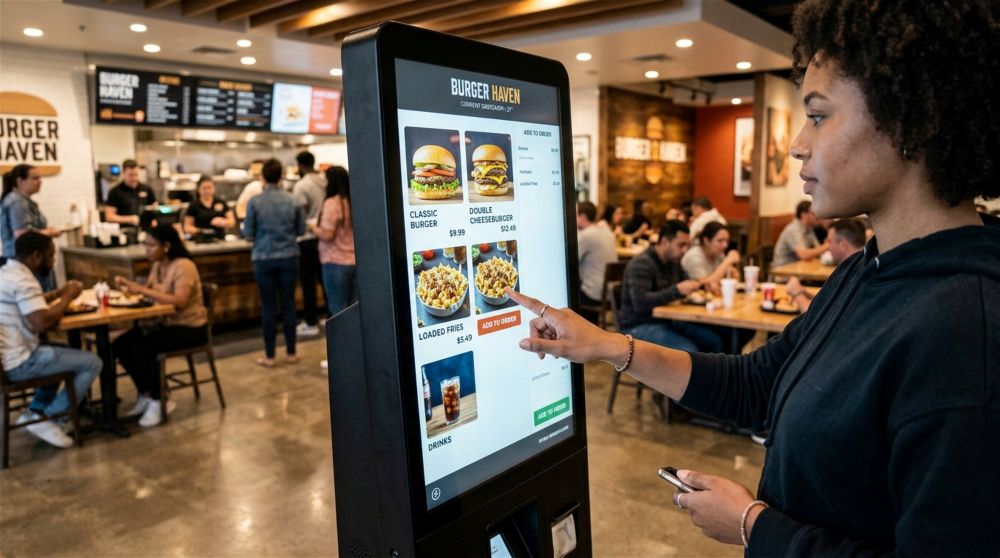
two kiosks from the same franchise, two different customer experiences
one kiosk employee juggling several roles at once
One Person, Many Roles

Why Are Mall Kiosks Harder to Control Than They Look?

A mall kiosk is small, but the employee’s role is not. One person may need to greet customers, demonstrate products, explain promotions, answer questions, process payments and manage stock. During busy hours, the same employee may also handle a complaint while serving another customer.

According to Salesforce retail research, 89% of retailers say the role of store associates is expanding. New store associates may also need to use an average of 16 different systems during their workday. The challenge becomes greater when 20 or more kiosks are operating across several malls or cities.

A message sent to one kiosk manager may not reach the evening shift. A new promotion may be explained correctly in one location but misunderstood in another. An experienced employee may follow the process while a temporary hire copies whatever they see around them. Small differences begin to appear in five important customer moments.
Five Moments That Make or Break the Brand

The Five Customer Moments Every Kiosk Must Get Right

1

The First Greeting

The greeting sets the tone for the interaction. One kiosk employee may welcome every visitor with a simple and friendly line. Another may wait until the customer asks a question. A third may begin talking about an offer before understanding what the customer needs. A franchise should define a clear greeting standard without forcing employees to sound like robots.

The standard may explain:
How quickly a customer should be acknowledged
Which opening line employees can use
How to approach someone who is browsing
When to give the customer more space
How the greeting may change during busy periods
The best way to teach this is through short examples. Employees can watch one correct interaction and one poor interaction. They can then answer a quick question about what made the first example better. This gives the employee a clear picture of the expected behaviour rather than asking them to remember a paragraph from a service manual.

2

Explaining the Product

Customers expect employees to understand what they are selling. This does not mean every kiosk employee needs to memorise every technical detail. However, they should be able to explain the main product benefit, identify the right option and answer common questions without providing different information at each location.

Customer experience can directly affect buying decisions. Salesforce reports that 88% of customers consider the experience provided by a company to be as important as its products or services.

A central product explanation should cover:
What the product does
Who it may be suitable for
The main difference between available options
The current price or offer
Common customer questions
Claims that employees should avoid making
When a manager should be involved
Franchise operators can use a Pitch Tool to give kiosk employees approved templates for customer conversations. Instead of creating their own explanation, employees can use centrally controlled content that keeps the brand message clear across locations.

3

Presenting the Current Offer

Promotions often create the greatest amount of confusion across kiosk networks.

The head office launches a weekend discount. The information is shared through email or a WhatsApp group. One manager explains it during the morning shift but forgets to brief the evening team. By the next day, customers are hearing different versions of the same offer.

A simple promotion update should answer:
What is the offer?
When does it begin and end?
Which products are included?
Are there any exclusions?
What should the employee say to the customer?
How will the offer appear during billing?
The message should reach every kiosk employee, not only the location manager. With Channel Co-Engage, a franchise can centrally manage approved communication and distribute it through channels such as WhatsApp and email. This can help make sure that important updates do not depend on managers forwarding messages manually.

4

Handling a Problem

A customer experience is tested most clearly when something goes wrong. The customer may want an exchange, question a price or complain about the quality of a product. One employee may immediately call a manager while another may try to solve a problem that is outside their authority. The franchise needs a simple service recovery process that employees can remember during a stressful interaction.

For example:
Listen
Confirm
Explain
Resolve or Escalate
The employee first listens without interrupting. They confirm that they understand the issue, explain the next step and either offer an approved solution or call a supervisor.

The process should clearly state:
Which problems employees can solve themselves
Which cases need manager approval
What language should be avoided
How long a customer should wait for help
Where the complaint should be recorded
Short role-play videos are useful here because tone and body language matter as much as the words being used. A written rule may say, "Show empathy." A realistic scenario shows employees what empathy sounds like during an actual complaint.

5

Ending the Interaction

The final few seconds can influence whether the customer remembers the experience positively. Employees should know how to close a sale, thank someone who did not purchase and guide a customer towards the next step. The closing standard may include:
Confirming that the customer has received everything
Explaining product care or usage
Mentioning the return or exchange process
Inviting the customer to visit again
Sharing an approved feedback or review link
Thanking the customer even when no sale was made
A customer who receives good service may be willing to share feedback. A franchise can use Review Management to track customer reviews and sentiment across different locations. This gives the central team more than a total star rating. It can reveal repeated patterns.

For example, several kiosks may receive positive feedback about staff friendliness but negative comments about waiting time. Another location may have good sales but repeated complaints about unclear offers. These signals help the franchise improve the exact part of the customer journey that needs attention.
Give Every Kiosk One Source of Truth
Stop the Scattered Files

Give Every Kiosk One Source of Truth

Customer experience becomes inconsistent when employees depend on scattered messages and old files. A service manual may be stored in email. Promotion details may be in a WhatsApp group. Product information may sit inside a PDF without use. The franchise should create one controlled source for:
Service standards
Product information
Current offers
Return and exchange rules
Customer complaint steps
Mall-specific instructions
Approved scripts
Store opening and closing checklists
Updates should be made centrally. Employees should always see the latest approved version without searching through previous messages.

Location information also affects customer experience before the shopper reaches the kiosk. Wrong operating hours, an outdated contact number or an incorrect mall location can damage trust. Presence Management can help organisations manage accurate location information, business details and branded location pages from one central dashboard.
Beyond Total Sales

Measure the Experience at Kiosk Level

Franchise operators often review total sales but may not see why one kiosk performs better than another. Customer experience should be measured through a small set of practical signals:
Training completion
Promotion knowledge scores
Customer feedback
Review sentiment
Complaint volume
Resolution time
Mystery shopping results
Repeat customer visits
Average transaction value
The purpose is to identify where the experience is changing. If one kiosk receives repeated complaints, the central team can check whether the problem comes from training, staffing, product knowledge or an unclear process. If another kiosk receives strong feedback, its service approach can become an example for the rest of the network.
Not a Script, a Framework

Standardise the Important Parts, Not Every Word

A consistent customer experience does not mean every employee must speak in exactly the same way. The franchise should standardise the important parts:
The information must be correct
The brand tone must remain respectful
Offers must be explained clearly
Problems must follow the approved process
Customers must know what happens next
Employees can still bring their own warmth and personality to the interaction. This balance helps the franchise protect the brand without making service feel forced.
FAQ

Frequently Asked Questions

How can a franchise maintain the same service across multiple kiosks?
The franchise should define clear customer service standards, create short role-based training and distribute product or promotion updates centrally. Customer feedback should also be reviewed by location to identify where service is changing.
Should kiosk employees follow fixed scripts?
Employees should have approved conversation frameworks rather than strict word-for-word scripts. This keeps important information correct while allowing employees to speak naturally.
How often should kiosk staff receive training?
Core onboarding should happen before the employee begins serving customers. After that, short updates can be sent whenever a product, promotion or process changes. Regular scenario-based refreshers can also help maintain service standards.
How can franchise operators identify weak customer experiences?
They can review customer feedback, online reviews, complaints, mystery shopping results and knowledge-check scores by location. Patterns are more useful than relying on one complaint or one manager’s opinion.
Can customer experience be standardised across different GCC countries?
Yes, but the core brand standards should be adapted for local language, mall rules and customer expectations. The service promise can remain common while examples and communication are adjusted for each market.
Still have questions? Our team is here to help you find the right solution.
Contact Support

Your Customers Should Experience the Same Clarity at Every Location

Your customers should experience the same clarity, service and brand confidence at every mall location. Discover how Amplispot helps distributed businesses manage customer communication and performance across every location at amplispot.com.
logo-Amplispot
Amplispot builds intelligent platforms that simplify communication and drive measurable business outcomes.
Phone:
+1 (718) 516-1216
+91 99307 33234
Sales and Support:

Enterprise:
© 2026 Amplispot. All rights reserved.
Founded 2017 · Headquartered in Mumbai, India · Serving customers globally
arrow-right
linkedin facebook pinterest youtube rss twitter instagram facebook-blank rss-blank linkedin-blank pinterest youtube twitter instagram