Most mutual fund distributors think about their competition as the distributor in the next locality, the one with more clients or a longer track record. But that is not where clients are actually being won or lost. The real competition is the digital presence of every other MF distributor that a prospect encounters online before they get on a phone call with you.
When an investor is referred to a distributor or simply searches for one, the first thing they do is look them up. 72% of investors visit an advisor's website during their research process and they form a trust impression in those first few seconds. If the distributor has no website or one that looks basic and unfinished, that impression works against them before a single conversation has happened.
This is why a distributor's online presence is not optional anymore. Investors are already browsing the polished platforms of AMCs and large financial institutions and they carry that visual standard into every comparison they make. A personal distributor website that does not match that level of credibility and design will struggle to convert even warm referrals into actual clients.
Key Takeaways
- Investors now research advisors online before committing to a relationship.
- Professional presentation reduces friction in the prospect-to-client journey.
- A strong online presence gives you a competitive advantage in financial services.
Why Apps Fail for Individual Distributors?
Apps work for large financial institutions with massive scale and brand recognition. Everyone knows the HDFC or ICICI app and they download it because they trust the brand and expect to use it regularly. But an individual distributor's app has none of that pull. There is no scale, no brand recognition and no compelling reason for an investor to download it.
Roughly 25% of users abandon an app after just one use and most people already have a phone full of apps they barely open. The majority of mobile users access fewer than 20 apps per month and spend half of their time using a single app. A distributor's app is almost certainly not going to make that list.
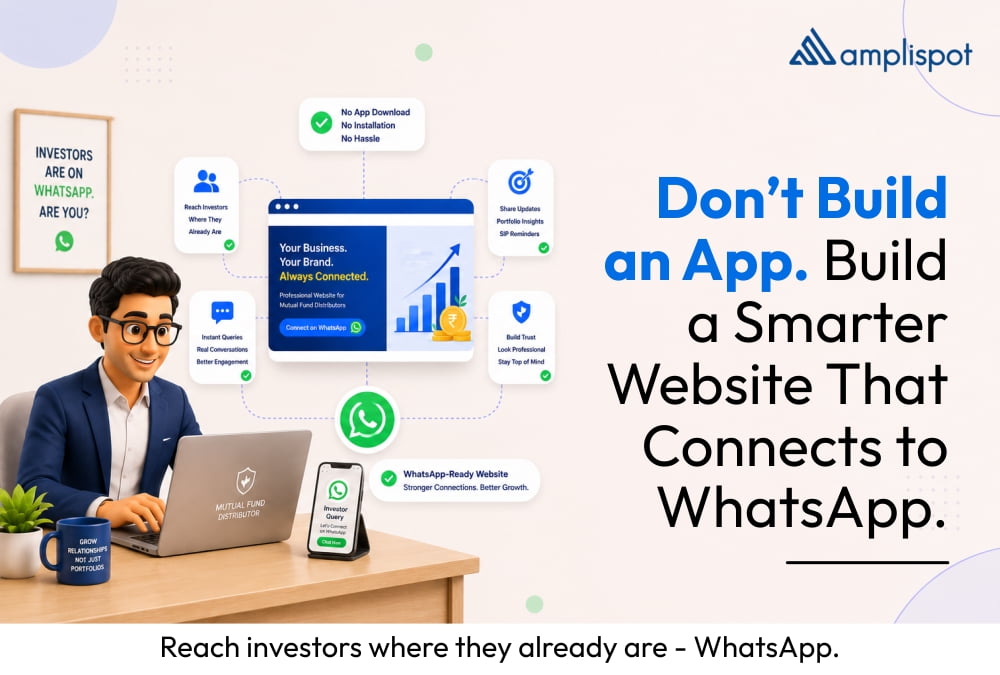
Apps also require ongoing maintenance, which means new versions, bug fixes and updates for new operating systems. Then there is the platform problem. Some investors use iPhones and some use Android, which means two versions of the app, more code, more bugs and more maintenance costs. A website works across every phone and every browser without any of this complexity. Someone clicks a link and they are in. Amplispot's Agent Websites are built on exactly this principle: mobile-first, zero friction and fully accessible across all devices without a single download.
WhatsApp Is Where Your Investors Actually Engage!
India has over 550 million WhatsApp users and near-universal smartphone penetration, making it the primary digital communication infrastructure for Indian businesses. Distributors already use it to send portfolio updates, market insights and fund recommendations. Investors use it to ask questions, request statements and stay connected. It is where the conversation naturally lives.
A WhatsApp-ready website leans into this reality. When a distributor's website has a button that opens a WhatsApp chat, the investor clicks it and the conversation begins immediately. No app to download, no new login to create and no unfamiliar interface to navigate. Just communication in the channel they already use every day.
60% of financial institutions already use WhatsApp for customer service and transaction notifications because they recognise that meeting clients where they are is more effective than pulling them into new channels. For individual distributors, this approach is even more powerful because it combines the credibility of a professional website with the accessibility of a platform their investors already trust and use daily.
A Mobile-First Website Gives You Everything an App Can Do
The best distributor websites are designed for phones from the ground up. They load fast, navigate easily with a thumb and work seamlessly on both 4G and WiFi without consuming significant data.
Distributors can also add progressive web app features that make the website feel app-like. The investor can save a shortcut to their home screen and when they tap it, it opens like an app. Technically it is still a website but the experience is indistinguishable. All the benefits of app behaviour with none of the development complexity or maintenance overhead.
For fund houses this simplicity has real value. Rather than investing in app development, the smarter investment is in distributor websites and WhatsApp enablement. Amplispot's platform supports exactly this through a combination of mobile-first agent websites and multi-channel communication tools that reach investors through the channels they already prefer.
The Real Value Is Trust and Availability, Not Technology
Investors do not care about technology for its own sake. They care about trust, responsiveness and results. 72% of investors say trust is the single most important quality they look for in a financial advisor and a distributor with a clean professional website and a responsive WhatsApp presence will outperform one with a fancy app who takes days to reply.
Frequently Asked Questions
Q: Is a website essential for financial advisors in 2026?
Yes. Investors expect online presence and research advisors digitally before committing. A professional website is now a baseline requirement, not a differentiator.
Q: How do you measure the success of an advisor's website?
Track metrics like engagement, inquiries, and conversations that start with someone discovering your website. These are the indicators of whether your digital presence is working.
Q: What's the biggest mistake financial advisors make with their websites?
Focusing too much on features and not enough on what matters to prospects. The best websites focus on demonstrating value and making it easy for interested parties to take the next step.
Ready to build a digital presence for your distribution network? Explore Amplispot at amplispot.com.